Hi friends! Today I'm going to talk about soldering irons used for making soldered jewelry. In this article I'll give you some helpful tips for how to choose the right soldering iron for jewelry making, finding the best soldering iron for jewelry, and I'll also explain why I recommend a high wattage (usually 80 to 100 watt) soldering iron for jewelry making.
Before we get started, if you aren't already a subscriber be sure to subscribe to my YouTube channel where I am always talking about soldering and soldering irons, teach projects, and announce new books and events so you don't want to miss that! Find it at: https://www.youtube.com/LauraBethLove
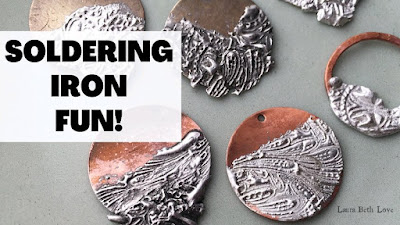
This type of jewelry - that is, jewelry made with a soldering iron - is sometimes called "low temp soldered jewelry" and the term "low temp" is used to differentiate this type of soldering from "high heat soldered jewelry" which would be jewelry that is made with a torch and a flame, such as when you are torch soldering sterling silver. That type of soldering requires an open flame.
Low temp soldered jewelry does NOT require an open flame. It only requires a soldering iron!
This type of jewelry making is also sometimes known as "soft soldered jewelry" but I think "low temp soldered jewelry" is a more accurate title. For the sake of this article, when I say "soldered jewelry" I am talking about jewelry that is created by using a soldering iron.
An example of soldered jewelry - the metalwork around the hearts is soldered (made by me, many years ago!)
You can buy soldering irons in different wattages. Look at any stained glass catalog and some jewelry making catalogs, or on Amazon and you'll find soldering irons called "irons for the hobbyist," or "irons for professionals," or "craft soldering irons," etc. But exactly what kind of soldering iron do you need for making soldered jewelry?
First of all, I get tons of emails from people who want to know what brand soldering iron they should buy. In my books I have recommendations for wattage but not for brands. Why? Because brand is a matter of personal preference.
Do I have my favorites? Sure I do (check out some of my favorites here). I've tried a variety of different brands of irons over the years - each is different from the next in some way. As to what would be "the best" really comes down to a matter of personal taste and preference. But I can tell you this: you get what you pay for.
Soldered jewelry, with vintage lace behind glass, by me, from around 2010, seen in my first book Boho Chic Jewelry
If you buy something very inexpensive called a "hobby soldering iron" that has a low wattage, you won't be able to get good results with it. How do I know this? Because it won't reach a high enough temperature to melt lead-free solder, and that's what you have to use to make soldered jewelry with a soldering iron.
Bracelet project from my book Soldered Alchemy
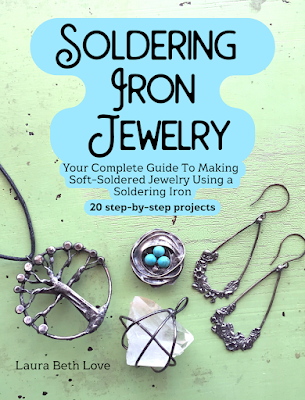
Most soldering irons are made for the stained glass industry and so they are made to melt lead which is used to create stained glass, and lead melts at a low temperature. Because we are making jewelry we need to use jewelry-safe lead-free solder. Lead-free solder melts at a higher temperature than lead does, so you need a higher wattage iron to be able to work with lead-free solder. (Want more info? I go into this in depth in my newest book, Soldering Iron Jewelry)
Note: If you use lead solder to make jewelry you are making poisonous jewelry. Using lead to make jewelry is against the law and you could get in much trouble for this. How do you tell the difference between lead solder in jewelry and lead-free solder in jewelry? First of all, The weight. Lead solder is heavy. Second of all, the finish. Lead solder can be polished to a super shiny finish that has virtually no visual imperfections. Lead-free solder will often have a hazy spot here or there and that is just the nature of the beast. It still will polish up to a nice shine with a little bit of elbow grease. Another way to tell whether it is lead or not is to simply do a lead test on that you can buy at a hardware store. And be advised, even if you put a patina on it or other coating, it is still lead and it is still against the law to use it in jewelry. So my point is, never use lead to make jewelry. Only ever use 100 percent lead-free solder!
OK, so we have established that you need a high wattage iron so that it can melt the lead-free solder. I recommend a 100 W soldering iron, or an 80 W. Sometimes people write to me and ask where they can find one, so now I have complied a list of my favorites that you can find here.
Can you use a lower watt iron? You might be able to, but you might not get as nice of a finish on your jewelry and it might not look as professional. Have you ever seen a piece of soldered jewelry where the metalwork is full of lumps, bumps, and sharp peaks? That is most likely the result of the person not using the correct temperature - and probably not the correct watt iron - to solder. (It can be the result of other things as well.)
Soldered jewelry - upcycled fork tines - from my first book, Boho Chic Jewelry
So if you can, get a 100 watt or 80 watt soldering iron. You will also need a rheostat which is used to adjust the temperature of your iron. You can buy soldering irons that have these built in to the handle or you can buy an external one that you plug your iron into.
I recommend the external one, but again that is my personal preference. I think they work better and I think it will prolong the life of your iron in case the rheostat breaks you can always get a new one if it's external. If the rheostat is built into your iron and it breaks, you're kind of out of luck.
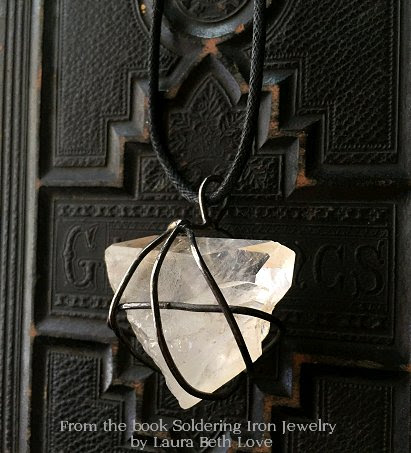
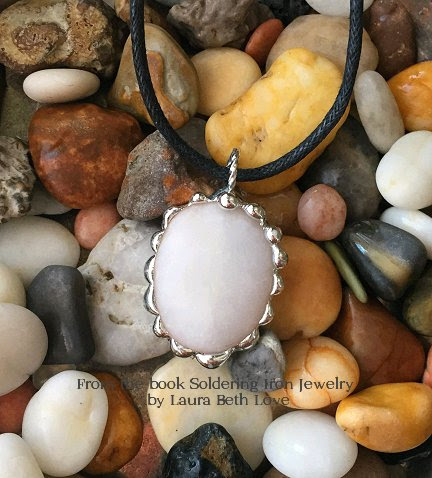
Soldered Crystal Pendant project from my book, Soldering Iron Jewelry
If you are just starting out with soldering or if you want a complete course from start to finish I highly recommend that you start with the Soldering Iron Jewelry book. (This book is for the newest beginner to the advanced solderer and offers a complete course plus 20 projects.) There you will also find my tips and techniques for decorative soldering and you will learn how I create those perfect little solder droplets to decorate my designs.
The Soldered Alchemy book is my second book and it is a bit more focused on using solder in a different way (a bit more sculptural and with wire), so I always tell folks to start with Soldering Iron Jewelry, and then move on to Soldered Alchemy and Boho Chic Jewelry. If you're already a soldering pro, then you definitely need to check out Soldered Alchemy. It will change the way you see and use solder and you will be amazed when you see these new techniques!
Boho Chic Jewelry is my first book and focuses a lot on upcycled jewelry made from personal mementos.
And if you didn't know, I also have tons of completely free videos on my YouTube channel where I teach my techniques as well as channel memberships if you are looking for even more info.
Soldered jewelry Stamped Spoon project- from my book, Boho Chic Jewelry
If you've never soldered jewelry before, or even held a soldering iron, this might seem like a lot of overwhelming information, but it really isn't.
Soldering is super fun, and if you have only ever worked with beads or wire and have never used heat to make jewelry, I definitely recommend giving soldering a try. You don't have to go directly from "cold wire" working to using a torch with a flame. Try soldering iron soldering! Once you get the hang of it you will be addicted!
Soldered stone project from the book, Soldering Iron Jewelry
You can do so many things with a soldering iron! What's especially neat about it is that you can solder items that you wouldn't be able to solder with an open flame torch, such as glass and plastic - which would break or melt from the flame of a traditional torch. So there are definite benefits to soldering iron soldering! ...and you can do it all right at your kitchen table.
Here's a peek of what you'll find inside:
I hope this article was helpful and informative. You should now know a few of the most important things about choosing a soldering iron for making lead-free, soft-soldered jewelry. I've really only scratched the surface here just to get you started on your journey - if you take just one piece of information away from this just please know that there is so much to learn about soldering and that anyone can do it!
Please leave me a comment on my Facebook page, and let me know what you think of soldering! Also let me know if there's anything else you'd like to see on my blog, and be sure to subscribe to my YouTube channel, where I will be adding new jewelry making and craft videos as I make them! Have fun soldering!
Free soft soldering videos (and lots of craft videos too) now on my YouTube channel! I hope you join me for my newest soft soldering video and that you find some inspiration watching, and while you're there don't forget to subscribe!
You might also like:
Article and images copyright ©Laura Beth Love 2013-2023 and may not be republished in print or other media without express written permission from the author. This article was originally published on 3/7/17 and updated in 2023.

.png)







.png)
.png)
.png)
.png)